A seasonal reminder: Jesus was not born in a stable, and it matters!
This morning'southward Thought for the Day on BBC Radio 4 by Sam Wells of St Martin's in the Fields once again repeated that familiar trope: Jesus was laid in an animal trough away from the support of immediate friends and family unit. The first is true; the second is a mistaken inference based on a misreading of the biblical texts and misunderstanding of the cultural context of the birth narratives. It is clear that even the great and the good need a reminder of what Scripture actually says, so I practice non apologise for reposting once more this annual feature.
Pic Jesus' nativity. Bethlehem boondocks sits nonetheless beneath the moonlight, totally unaware that the son of God has been built-in in one of its poor and lowly outbuildings. In an anonymous backstreet, tucked away out of sight, nosotros find a draughty stable. Inside, warm with the heat of the animals, a family sits quietly. Lit by a warm glow, a ass, cow and an ox lie serene at the side of the scene. The cow breathes out a gentle moo and the baby in the straw filled manger stirs. Kneeling shut by Mary, Joseph and a small lamb sit in silent adoration of the child. All is calm, all is not quite right.
I am deplorable to spoil the scene, but Jesus wasn't born in a stable, and, curiously, the New Testament hardly even hints that this might have been the instance. This might shatter the Christmas card scenes and cutting out a few characters from the children's birth line-up, just it'due south worth paying attention to.
This long-held idea demonstrates just how much we read Scripture through the lens of our own assumptions, culture, and traditions, and how hard information technology can be to read well-known texts carefully, attending to what they actually say. It also highlights the power of traditions, and how resistant they are to change. And, specifically, the belief that Jesus was lonely and dejected, cast out amongst the animals and side-lined at his nascency, loses sight of the style in which Jesus and his birth are a powerfully disruptive force, bursting in on the middle of ordinary life and offer the possibility of its transformation.
Then where has the idea come from? I would track the source to three things: traditional elaboration; issues of grammar and meaning;and unfamiliarity with first-century Palestinian civilization.
The traditionalelaboration has come about from reading the story through a 'messianic' agreement of Is one.3:
The ox knows its main, the donkey its owner'due south manger, merely Israel does not know, my people do non understand.
The mention of a 'manger' in Luke'southward nativity story, suggesting animals, led mediaeval illustrators to draw the ox and the ass recognising the baby Jesus, then the natural setting was a stable—later all, isn't that where animals are kept? (Answer: not necessarily!)
The issue of grammar and meaning, and perchance the heart of the matter, is the translation of the Greek discussionkatalumain Luke 2.7. Older versions translate this as 'inn':
And she brought forth her firstborn son, and wrapped him in swaddling wearing apparel, and laid him in a manger; because there was no room for them in theinn. (AV).
At that place issome reason for doing this; the word is used in the Greek Old Testament (the Septuagint, LXX) to translate a term for a public place of hospitality (eg in Ex 4.24 and ane Samuel nine.22). And the etymology of the word is quite full general. It comes fromkataluomeaning to unloose or untie, that is, to unsaddle 1's horses and untie i's pack. But some fairly decisive evidence in the contrary direction comes from its use elsewhere. It is the term for the private 'upper' room where Jesus and the disciples eat the 'last supper' (Mark 14.xiv and Luke 22.11; Matthew does not mention the room). This is clearly a reception room in a private dwelling house. And when Luke does mention an 'inn', in the parable of the man who fell among thieves (Luke x.34), he uses the more full general termpandocheion, significant a identify in which all (travellers) are received, a caravanserai.
The difference is made clear in this pair of definitions:
Kataluma (Gr.) –"the spare or upper room in a private house or in a village […] where travelers received hospitality and where no payment was expected" (ISBE 2004). A private lodging which is distinct from that in a public inn, i.eastward. caravanserai, or khan.
Pandocheion,pandokeion,pandokian (Gr.) – (i) In fifth C. BC Hellenic republic an inn used for the shelter of strangers (pandokian='all receiving'). The pandokeion had a common refectory and dormitory, with no carve up rooms allotted to individual travelers (Firebaugh 1928).
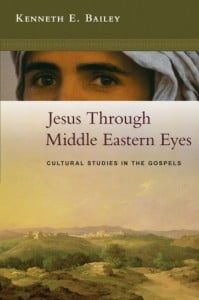 The3rd effect relates to our agreement, or rather ignorance, of (you guessed it) the historical and social context of the story. In the get-go place, information technology would exist unthinkable that Joseph, returning to his place of ancestral origins, would non have been received by family unit members, fifty-fifty if they were not close relatives. Kenneth Bailey, who is renowned for his studies of first-century Palestinian culture, comments:
Even if he has never been there before he tin appear suddenly at the home of a distant cousin, recite his genealogy, and he is among friends. Joseph had only to say, "I am Joseph, son of Jacob, son of Matthan, son of Eleazar, the son of Eliud," and the immediate response must accept been, "Y'all are welcome. What tin can nosotros do for you?" If Joseph did have some member of the extended family resident in the village, he was honor-spring to seek them out. Furthermore, if he did not have family or friends in the village, as a fellow member of the famous firm of David, for the "sake of David," he would still be welcomed into almost any village home.
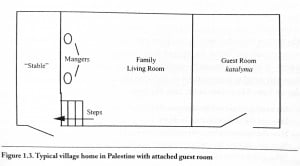 Moreover, the bodily pattern of Palestinian homes (fifty-fifty to the present day) makes sense of the whole story. As Bailey explores in hisJesus Through Middle-Eastern Eyes, most families would live in a single-room house, with a lower compartment for animals to be brought in at night, and either a room at the back for visitors, or space on the roof. The family living area would usually have hollows in the basis, filled with hay, in the living expanse, where the animals would feed.
This kind of ane-room living with animals in the house at dark is evident in a couple of places in the gospels. In Matt 5.fifteen, Jesus comments:
Neither exercise people lite a lamp and put it nether a bowl. Instead they put it on its stand up, and it gives light to everyone in the business firm.
This makes no sense unless anybody lives in the one room! And in Luke'due south account of Jesus healing a woman on the sabbath (Luke 13.ten–17), Jesus comments:
Doesn't each of you lot on the Sabbath untie your ox or donkey from the manger [same word as Luke 2.7] and atomic number 82 it out to requite it water?
Interestingly, none of Jesus' critics reply, 'No I don't touch animals on the Sabbath' because they all would accept had to lead their animals from the business firm. In fact, one belatedly manuscript variant reads 'atomic number 82 it outfrom the firmand requite it water.'
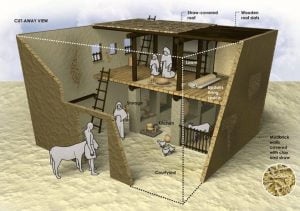 What, then, does it mean for thekataluma to take 'no space'? It means that many, like Joseph and Mary, have travelled to Bethlehem, and the family guest room is already full, probably with other relatives who arrived earlier. And so Joseph and Mary must stay with the family unit itself, in the main room of the house, and at that place Mary gives birth. The most natural place to lay the baby is in the hay-filled depressions at the lower end of the house where the animals are fed. The idea that they were in a stable, away from others, alone and outcast, is grammatically and culturally implausible. In fact, it is hard to exist solitary at all in such contexts. Bailey amusingly cites an early researcher:
Anyone who has lodged with Palestinian peasants knows that notwithstanding their hospitality the lack of privacy is unspeakably painful. One cannot have a room to oneself, and one is never alone by twenty-four hours or by night. I myself often fled into the open country but in order to be able to call up
In the Christmas story, Jesus is not pitiful and alone, some distance abroad in the stable, needing our sympathy.
Rather, he is in the midst of the family, and all the visiting relations, right in the thick of it and demanding our attention.
This should fundamentally change our approach to enacting and preaching on the nativity.
Merely ane last question remains. This, informed and persuasive, agreement of the story has been around, even in Western scholarship, for a long, long fourth dimension. Bailey cites William Thomson, a Presbyterian missionary to Lebanese republic, Syria and Palestine, who wrote in 1857:
It is my impression that the birth actually took place in an ordinary house of some common peasant, and that the infant was laid in 1 of the mangers, such every bit are nonetheless establish in the dwellings of farmers in this region.
And Bailey notes that Alfred Plummer, in his influential ICC commentary, originally published in the tardily nineteenth century, agreed with this. And then why has the wrong, traditional interpretation persisted for and so long?
 I think there are two principal causes. In the first place, nosotros detect it very difficult to read the story in its ain cultural terms, and constantly impose our own assumptions about life. Where do you keep animals? Well, if you live in the West, peculiarly in an urban context, abroad from the family of course! And so that is where Jesus must have been—despite the experience of many who live in rural settings. I remembering noticing the place for cattle underneath the family home in houses in Switzerland.
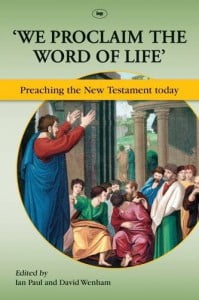
Secondly, it is easy to underestimate how powerful a hold tradition has on our reading of Scripture. Dick France explores this effect alongside other aspects of preaching on the infancy narratives in in his excellent chapter inWe Proclaim the Word of Life.He relates his own feel of the effect of this:
[T]o abet this understanding is to pull the rug from under not only many familiar carols ('a lowly cattle shed'; 'a draughty stable with an open door') but besides a favourite theme of Christmas preachers: the ostracism of the Son of God from human society, Jesus the refugee. This is subversive stuff. When I get-go started advocating Bailey's interpretation, information technology was picked up past a Dominicus paper and so reported in various radio programmes every bit a typical example of theological wrecking, on a par with that then notorious debunking of the actuality of the resurrection by the Bishop of Durham!
So is it worth challenging people's assumptions? Yep, it is, if you recall that what people need to hear is the actual story of Scripture, rather than the tradition of a children'south play. France continues:
The trouble with the stable is that it distances Jesus from the rest of us. It puts even his nativity in a unique setting, in some ways equally remote from life as if he had been built-in in Caesar's Palace. But the message of the incarnation is that Jesus is one of united states. He came to be what nosotros are, and it fits well with that theology that his nascence in fact took place in a normal, crowded, warm, welcoming Palestinian home, only like many some other Jewish boy of his fourth dimension.
And who knows? People might even start asking questions about how nosotros read the Bible and empathise information technology for ourselves!
If y'all would like to see how it might be possible to re-write the Christmas story for all ages in a way which is faithful to this, run into this excellent case from Stephen Kuhrt.
I preached on this theme at a Carol Service, and you lot tin can read my sermon here.
Additional note
I am grateful to Mark Goodacre for cartoon my attention to an first-class paper on this by Stephen Carlson, then 1 of his colleagues at Duke. The paper was published in NTS in 2010, merely is available on Carlson'south web log for free. Carlson presses the argument even further by arguing three points:
1. He looks widely at the utilize ofkataluma and in particular notes that in the Septuagint (70, the Greek translation of the OT from Hebrew in the second century BC) information technology translates a broad variety of Hebrew terms for 'places to stay.' He thus goes further than Bailey, agreeing that it does not mean inn, simply instead that it refers to any place that was used every bit lodgings.
ii. He looks in detail at the phrase ofttimes translated 'there was no room for them in thekataluma' and argues that the Greek phraseouch en autois topos does non mean 'there was no roomfor them' but 'they had no room.' In other words, he thinks that theydid stay in thekataluma, but that information technology was not big enough for Mary to give birth to Jesus in, so she moved to the master room for the birth, assisted by relatives.
3. He believes that Bethlehem was not Joseph's ancestral dwelling, but his actual family abode, for two reasons. Firstly, we have no tape of any Roman demography requiring people return to theirancestral home. Secondly, he argues that the phrase in Luke 2.39 'to a town of their own, Nazareth' doesn't imply that they were returning to their home town, but that they then made this their domicile. Nosotros already know this is Mary's domicile town, and it would be usual for the adult female to travel to the human being's home town (Joseph'south Bethlehem) to complete the betrothal ceremonies. After Jesus is born, they then render together to set up home near Mary's family.
Thekataluma was therefore in all likelihood the actress accommodation, possibly just a single room, possibly built on the roof of Joseph'southward family unit'southward home for the new couple. Having read this, I realised that I had stayed in merely such a roof-room, jerry-built on the roof of a hotel in the Old City of Jerusalem, in the lee of the Jaffa Gate, in 1981. It was small, and there was certainly no room to give birth in information technology!
(Yous can stay there besides, by booking here. The site includes the view we had from the roof!)
Every bit nosotros approach Advent, how do nosotros make sense of the linguistic communication in the New Testament most the 'finish of the world'? Why is it pastorally important to become this right? Is all the language about 'rapture', 'tribulation' and 'millennium' helpful—or a distracting fiction?
Come and find out at Ian Paul's Zoom instruction morning on Sat 4th December:
https://www.eventbrite.com/e/making-sense-of-the-end-of-the-world-tickets-207768409907
stewartcrusuppeas.blogspot.com
Source: https://www.psephizo.com/biblical-studies/a-seasonal-reminder-jesus-was-not-born-in-a-stable-and-it-matters/
0 Response to "A seasonal reminder: Jesus was not born in a stable, and it matters!"
Post a Comment